How AI Agents Reduce Alert Fatigue Without Hiding Evidence
Alert fatigue isn't solved by deleting alerts. It's solved by grouping related signals and making every suppression or priority decision explainable to review.
How AI Agents Reduce Alert Fatigue Without Hiding Evidence
Alert fatigue is not solved by deleting alerts. It is solved by giving analysts better context, grouping related signals, and making every suppression or prioritisation decision explainable.
Group before you prioritise
An agent can connect repeated alerts to the same host, identity, process, or time window. The analyst sees one incident story instead of twenty disconnected notifications.
Show why the priority changed
Every priority recommendation should name the evidence: asset criticality, user history, related detections, or a known benign pattern. A silent score is difficult to trust.
Measure the outcome
Track time to first useful decision, false-positive rate, reopened incidents, and recommendations corrected by analysts. A lower alert count is not success if important signals disappear.
Four ways to shrink a queue, and how much evidence each one hides
"Reducing alerts" covers methods that hide very different amounts of evidence, roughly from least to most hidden, in our judgement. "Documented" means zcr's documentation says so, "Recommended pattern" is our advice, "Customer configuration" is yours to set.
- Grouping: several alerts become one incident. Done well, the originals stay attached and openable (see step 1). Documented: zcrSIEM groups alerts from multiple controls into one incident linked to hosts, users, IPs and timelines.
- Re-ranking: the item stays but moves. Documented: zcrSIEM scores risk from severity, confidence, criticality, privilege, CVE/CVSS and MITRE ATT&CK context.
- Exceptions: a matching alert does not become analyst work. Documented: zcrSIEM custom and Sigma-based rules support thresholds, time windows, aggregation and exceptions. Customer configuration: what each exception matches. Recommended pattern: log each exception with owner, reason, scope, review date and what it suppressed.
- Source-side filtering: treat an event the collector excludes as gone; no detection rule will see it. Documented: zcrSIEM filters at the local or source-side collector with Include, Exclude, Field Filtering and Routing rules. Recommended pattern: exclude only data you will never investigate, and confirm what happens to excluded events.
Recommended pattern: an agent may propose a grouping, rank or exception; an analyst or an owned rule applies it, and exceptions and source-side filtering need a named approver.
Documented: zcrSOAR turns triage into a pull queue. Recommended pattern: push only what cannot wait, and let the rest be pulled (check your notification setup).
One alert's path, from grouping to rule feedback
Illustrative alert: a web-attack rule firing repeatedly on one public host. Each "must still see" is a check for your tenant, not a screen description.
- Group related alerts: the repeated alerts become one incident. What counts as a duplicate, and how long the window runs, are your team's decisions. Must still see: the alert count, the value that tied the group together, and every member alert, openable.
- Enrich and rank: UEBA compares the host with its normal behaviour, threat intelligence is correlated with internal logs, and the risk score above orders the item (documented). Must still see: the factors behind the score, the item's position before and after ranking, and each piece of context with its source and lookup time ("no match" kept apart from "lookup failed").
- Summarise, with a route to raw evidence: zcrSIEM summarises incidents, timelines and threat context (documented). Must still see: the event or query behind each sentence (test that your tenant provides it) and an AI-generated label.
- Analyst decision: zcrSIEM keeps analyst notes, evidence, assignment and status history (documented). Must still see: whether the incident was opened before it was closed, and the AI recommendation kept apart from the analyst's decision, with a reason when they differ.
- Feedback into rules: an incident closed as benign or duplicate feeds a rule review: adjust a threshold, add an exception or retire the rule (recommended pattern). Must still see: which past alerts a proposed exception would have covered before it starts, and what it has suppressed since.
Process measures that show fatigue is falling
Outcome measures are covered above; these process measures are a recommended pattern with no numeric targets.
| Measure | What it tells you | Where the data comes from | How it can be gamed |
|---|
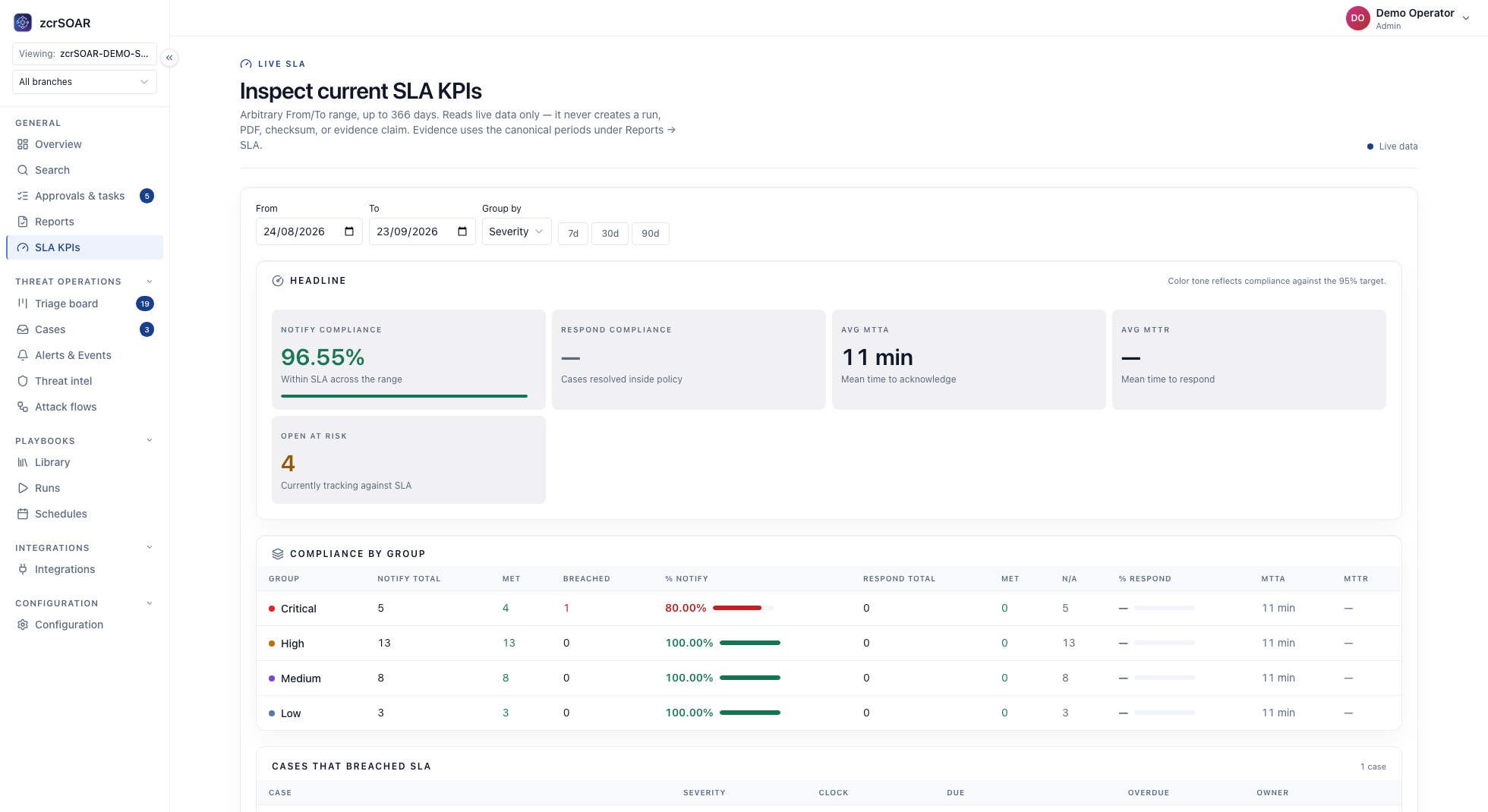
| Notify and Respond SLA by severity, and age of the oldest unpulled item | Whether the queue is pulled in time and nothing sits forgotten | Documented: zcrSOAR per-severity SLA reporting (mean times, breach list) and incident tracking. Your records: item age from timestamps | Acknowledging to stop the clock unread, lowering severity at intake, bulk-closing |
| Incidents an analyst found wrongly grouped (two stories merged, or one split) | Whether grouping hides real activity or leaves noise | Your records: analyst notes in an agreed wording | Nobody records it; it looks like the tool failed |
| Exceptions and source-side exclusions past their review date | Whether suppression piles up unreviewed | Your records: an exception register | Pushing review dates out, or splitting a broad exception into small ones |
| Second-reviewer disagreement on a sample of incidents closed as benign | Whether noise reduction costs real detections | Your records: sampled review records | Sampling only easy cases, or reviewers who always agree |
Read the measures in pairs: faster pulling together with more second-reviewer disagreement suggests a faster, worse queue until something else explains it.
Limits, failure modes and escalation triggers
Recommended pattern unless marked documented.
- Over-grouping: a shared service account, jump host or NAT address pulls unrelated activity into one incident and buries the second story. Trigger for review: the value that tied the group together is a shared entity.
- A summary the evidence does not support: trigger for review: an analyst finds one sentence with no supporting event, even once. Read raw events for that incident type until reviewed.
- A silent source: a source stops sending, alerts fall, and everyone sees a calmer queue. Rule out a collection fault before calling it a win: compare each source's last event time with its usual rhythm.
If a reopened incident traces to an alert that grouping or an exception hid, pause that rule or exception until the SOC lead decides.
If alerts arrive when nobody is on shift to pull from the queue, tuning will not help. Documented: zcrMDR is a managed service delivered through an approved channel partner; integrations, response actions and SLA are defined during onboarding, and coverage levels in the agreement. Ask which alerts the provider triages and which come back to you.
Frequently asked questions
Does merging alerts into one incident hide evidence?
Not necessarily, if the underlying alerts stay openable and you can see what tied them together. Grouping can still bury a second story when the key is a shared account or NAT address. The bigger risk is exceptions and source-side exclusions, which never show up as work for anyone.
Should an AI close low-risk alerts by itself?
Not by default. Recommended pattern: the AI proposes and an analyst or an owned rule decides, even after a clean review sample, because a clean sample lowers the risk but cannot show that nothing was missed. In zcrSOAR each playbook step is set to Autonomous, Approval or Blocked (documented); set any step that closes or hides a case to Approval (recommended pattern).
The queue is already too big. Where do we start?
Take the few rules that generate the most work. If nobody can say when one last led to a useful decision, fix or retire it, with an owner and review date, rather than adding a quiet exception. Ask the team too (recommended pattern): "which alert types did you skip this week without opening them?"
Continue: From Alert to Evidence: An Auditable AI SOC Workflow, Human-in-the-Loop SOC, AI SOC Agent vs SIEM Rules and the AI SOC Agent guide.
Explore zcrMDR · Compare pricing · Contact zcr
If you'd rather talk through your own environment, here's how to reach us.