What Is an AI SOC Agent? A Practical Guide for Security Teams
An AI SOC agent collects security context, investigates a defined question, and recommends the next action, but it isn't an unsupervised analyst replacement.
What Is an AI SOC Agent? A Practical Guide for Security Teams
An AI SOC agent is software that can collect security context, investigate a defined question, and recommend the next action inside a security operations workflow. It is more capable than a static detection rule, but it should not be treated as an unsupervised replacement for an analyst.
The useful question is not “Can an AI agent run the SOC?” It is “Which SOC steps can an agent perform reliably, with evidence and a clear approval boundary?”
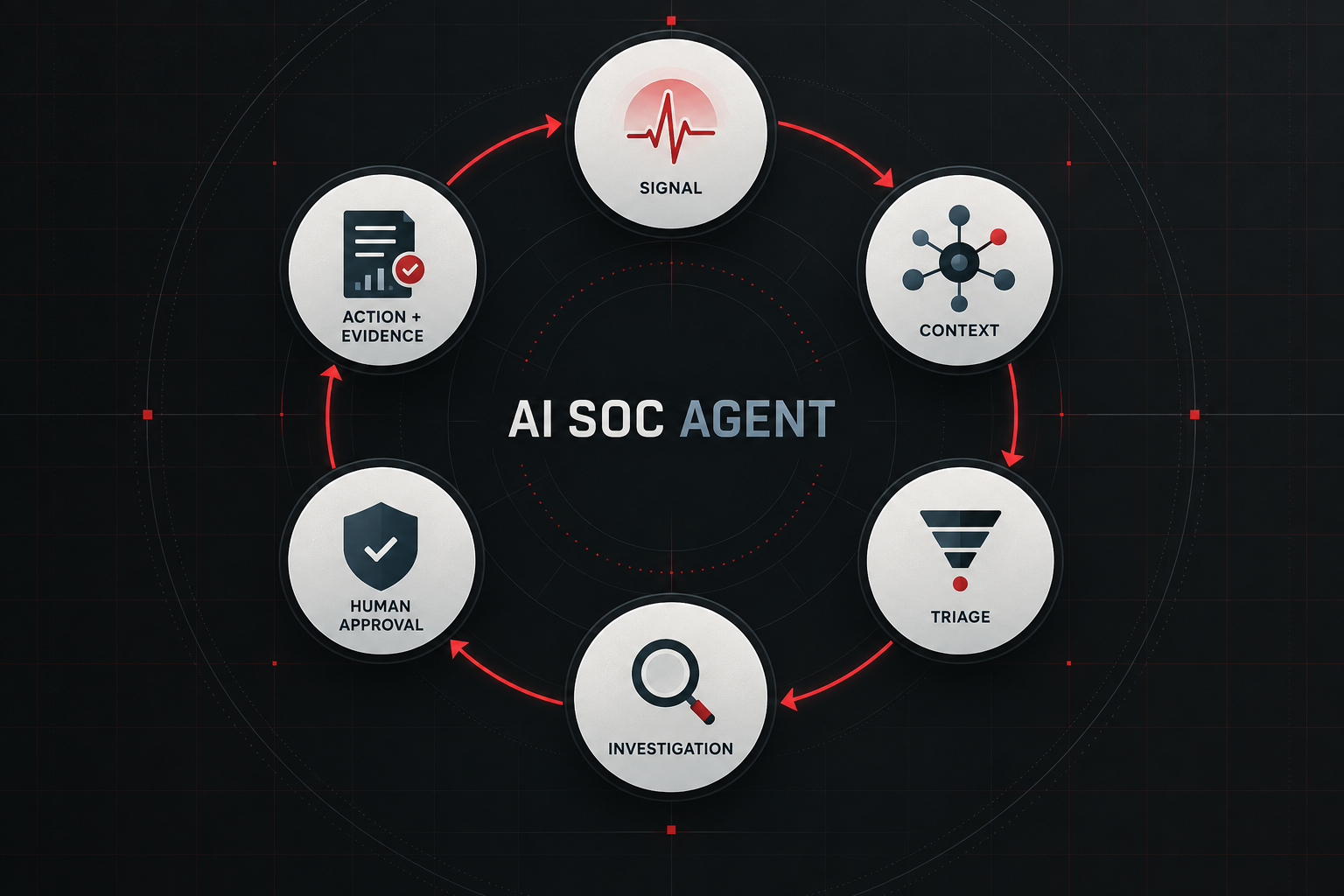
The operating loop
- Signal — an EDR, firewall, identity system, cloud service, or SIEM produces an alert.
- Context — the agent gathers related events, asset identity, user history, threat intelligence, and the detection rule that fired.
- Triage — it groups duplicate alerts, explains why the signal matters, and proposes a severity with supporting evidence.
- Investigation — it runs approved queries and checks a bounded set of sources.
- Decision — a qualified analyst reviews the evidence and approves, rejects, or requests more investigation.
- Action and record — the approved response runs through the existing playbook and the evidence is recorded for review.
This loop makes the agent accountable: every recommendation has a source, every action has an owner, and the organisation can reconstruct what happened later.
What an agent can do well
An agent is particularly useful for repetitive, evidence-heavy work:
- summarising an alert in plain language;
- finding related events across a defined time window;
- translating a hunting question into a reviewable query;
- comparing the signal with asset and identity context;
- suggesting a severity, ATT&CK technique, or next investigation step;
- drafting an incident or executive report.
These tasks help analysts spend more time on judgement and less time switching between consoles. They do not remove the need for good telemetry, documented playbooks, or experienced review.
Where human approval belongs
Keep a human approval gate before actions that can disrupt business operations, change access, delete evidence, or create a legal or customer commitment. Examples include isolating a production server, disabling an account, blocking a business-critical domain, or closing an incident as benign.
The approval screen should show the evidence used, the proposed action, its expected effect, and a rollback path. The agent should have the least privilege needed for its task, and its tool calls should be recorded in an audit trail.
AI-assisted, not AI-washed
Calling a feature “AI-powered” is not enough. A credible SOC design answers four questions:
- What data can the agent read?
- Which tools can it call?
- Which actions require approval?
- How can an analyst verify and correct its conclusion?
If the answers are unclear, the organisation has added automation without adding control.
How this maps to a practical stack
An AI SOC agent needs a reliable source of security context and a controlled response layer. zcrSIEM provides centralised detection, investigation, and reporting, with natural-language questions converted into queries that analysts can review. zcrSOAR provides the playbook and response workflow. zcrMDR is a managed service delivered through an agreed partner. For teams that need analyst capacity, it provides managed detection and alerting, human-reviewed response, and reporting. Coverage hours and scope are set in the contract.
The exact integrations, response actions, and SLA should be agreed during onboarding. Existing EDR environments such as CrowdStrike or SentinelOne can remain part of the operating model when the integration and scope are defined.
A safe 30-day starting point
Start with one narrow workflow: alert summarisation and related-event collection. Measure analyst review time, false-positive handling, evidence completeness, and the number of recommendations that required correction. Expand to query translation and report drafting only after the first workflow is repeatable. Whatever you automate, preserve the raw evidence before any remediation runs, so a reviewer can compare what the agent saw with what the response changed.
An AI SOC agent earns trust through transparent evidence, bounded permissions, and measurable outcomes. The goal is a faster and more consistent security operation that keeps people accountable for consequential decisions.
Continue the series
Continue: AI SOC Agent vs SIEM Rules: What Each One Should Do, How AI Agents Reduce Alert Fatigue, and What Is Agentic AI in the SOC?, which explains how agentic AI differs from regular AI assistance and where a person still approves.
Explore zcrSIEM · Compare pricing · Contact zcr.
If you'd rather talk through your own environment, here's how to reach us.