AI-Assisted SOC vs Autonomous SOC: Choosing the Right Operating Model
The right SOC operating model depends on business impact and evidence quality, not on how autonomous the marketing sounds. Here's how to choose between them.
AI-Assisted SOC vs Autonomous SOC: Choosing the Right Operating Model
The right operating model depends on business impact, evidence quality, and the team’s ability to review outcomes—not on how autonomous the marketing sounds.
Choose assisted when judgement is central
AI-assisted workflows are a strong fit for investigation, triage, reporting, and analyst learning when actions are consequential or data is incomplete.
Choose bounded autonomy for repeatable low-risk work
Automation can handle enrichment, deduplication, ticket routing, and approved notifications when the failure impact is limited and observable.
Define the escalation contract
Write down who owns the decision, what evidence is required, when the agent must stop, and how a human is reached.
Autonomy is set per action, not per product
In a real SOC autonomy is set action by action: an incident summary is assisted work, isolating a laptop after sign-off is approved automation, and attaching an IP reputation lookup to a ticket can run without anyone approving it first.
Two properties place an action: reversibility and blast radius (one test laptop, or a domain controller). Recommended pattern: steps that only read or annotate and can be undone, such as a lookup, a note or a tag, are candidates for bounded autonomy. Steps that change production state start with a sign-off, even when narrow and reversible, and irreversible or wide ones stay with a person; Human-in-the-Loop SOC covers grading. OWASP's LLM guidance supports the approval half: it names excessive functionality, permissions and autonomy as typical root causes of "Excessive Agency" and lists human approval of high-impact actions as a mitigation; reversibility and blast radius are our criteria, not OWASP's.
Decision table: three operating models
A recommended pattern, not a description of one product.
| Dimension | AI-assisted | Human-approved automation | Bounded autonomy |
|---|
| Who decides | The analyst; the AI prepares summaries and draft queries | A named approver; the AI proposes, the platform executes after sign-off | Your written policy; the AI acts only inside a pre-approved list |
| Typical actions | Summaries, draft searches for review, suggested next steps | Isolate an endpoint, disable an account, block an indicator | Tags, notes, tickets, read-only searches; only reversible steps on a pre-approved list |
| Evidence trail | Analyst notes, AI inputs, the query the analyst reviewed | The same, plus proposal, approver, approval time, result | The same, plus the allowing policy and sample reviews |
| Staffing implication | An analyst on every case; capacity grows with headcount | Approvers reachable in the response window, off-hours included | An owner who reviews outcomes and keeps the allow-list; least routine work, not none |
| Where a mistake is caught | By the analyst before anything runs, if the evidence is checked and not only the summary | By the approver, if the proposal is read; a rubber-stamped approval executes the mistake | Not beforehand; later, through sample reviews, so keep the list narrow and reversible |
| When to choose it | Incomplete data, critical assets, a new team, a first deployment | Business-relevant actions too urgent to do by hand | Repetitive, low-impact, reversible work that has run under approval long enough to trust |
| Example: failed sign-ins on a service account | The AI drafts the timeline and a query; the analyst decides | The AI proposes disabling the account; a named approver signs off after reading the evidence | The AI adds the IP reputation result to the ticket as a note and leaves the account alone |
Four questions to put to any vendor
Recommended pattern. A good answer follows each question.
- Which actions run at which level, and can I edit that list? Good: a per-action list, not one autonomy setting.
- What can the AI reach: credentials, connectors, scopes? Good: least privilege per connector, with permission checks in the downstream system, not trust in the model.
- Who approves each action type, and what happens when nobody answers? Good: named roles, a timeout, and hold or escalate as the fallback.
- Can each action be undone, and what record does it leave? Good: a defined undo step, and input, evidence, approver and result an auditor can read.
What zcr documents, and what stays your decision
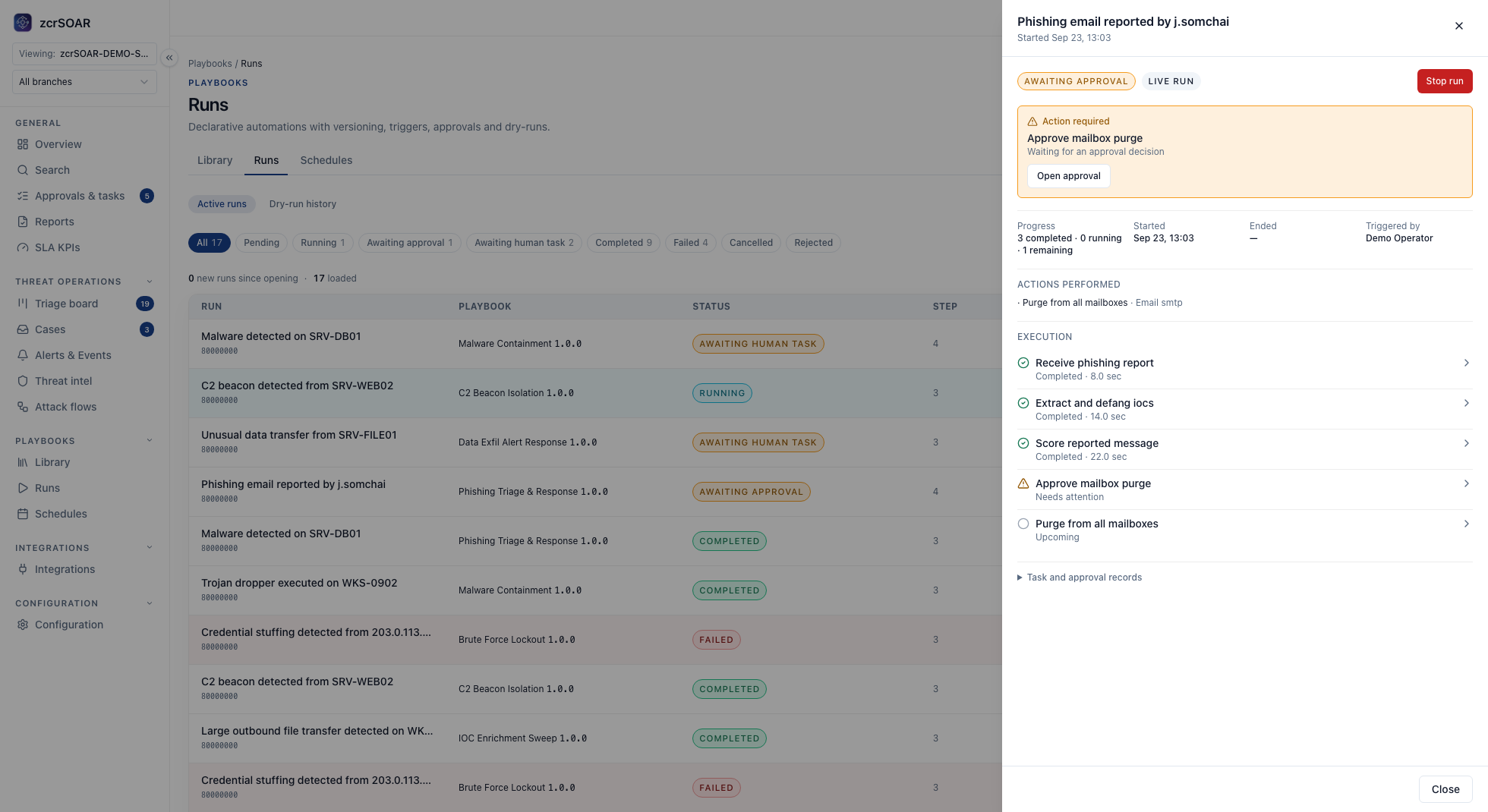
Documented in zcr. In zcrSOAR each playbook step is set to Autonomous, Approval or Blocked: Autonomous steps run immediately, Approval steps wait for a role-gated sign-off, Blocked steps do not run until the gating changes. Unapproved playbooks stay in Draft, Test, Dry-run or Simulation Mode until the organisation authorises production, and each response action is recorded with user, input, result and status. zcrSIEM turns a natural-language question into a query the analyst can review, but it does not include SOAR; approvals and containment actions belong to zcrSOAR.
Our mapping (recommended pattern, not a documented feature). Approval corresponds to human-approved automation, Autonomous to bounded autonomy, and Blocked is the floor under every model; assisted work is manual, with zcrSIEM's reviewable queries. The documented gating covers playbook steps, not an AI agent's own tool calls, so putting an AI component under these levels is your design.
Managed services. zcrSOC and zcrMDR are delivered through an approved channel partner. zcrSOC Essential covers alert acknowledgement, triage and monthly reporting; Response adds coordinated response, escalation and IR support. Coverage hours are set in the agreement. Recommended pattern: list there the actions the service may take and who approves them.
Customer configuration. Which steps are Autonomous, who approves, and which assets are business-critical.
Limits, failure modes and escalation triggers
Approval queues can fail quietly: if approvers accept nearly everything, or a step is raised to Autonomous to clear the queue, the human step is only a delay. zcrSOAR lets you monitor approval queues and open approval records. Recommended pattern: use them to find stalled requests and approvals that pass unread, and settle the off-hours rule beforehand (an on-call approver, a managed-service window, or an action that waits).
Recommended pattern: an owner you name may pull an action back one level (Autonomous to Approval, Approval to manual); in zcrSOAR that is a change to the step's gating. Do it when:
- it touched a target outside its intended scope;
- an undo did not restore the previous state (isolating a host is reversible on paper, but not while it runs a job the business needs);
- its inputs were incomplete or stale, such as a silent log source;
- reviewers cannot explain from the record why it ran;
- the target became business-critical.
Frequently asked questions
Should we aim for a fully autonomous SOC?
Not as a target. Bounded autonomy fits steps that only read or annotate and can be undone; containment, irreversible actions and business-critical assets keep a person in the decision.
Can a short-staffed team use bounded autonomy to close the gap?
Only for read-only and annotating steps such as a note, a tag or a lookup. Missing analysts are not a reason to raise a containment step to Autonomous; add approvers, agree what waits off-hours, or contract a managed service through an approved channel partner.
How do we move from one operating model to the next?
Recommended pattern: begin with AI-assisted work, then move a step to Approval after running it in Dry-run or Simulation Mode. Raise it to Autonomous only if it is reversible, has run under approval for a review period with no approval later reversed, and has a tested undo path.
Sources
Continue: How to Start an AI SOC Program Without Replacing Your Existing Stack, What Is Agentic AI in the SOC? and the AI SOC Agent guide.
Explore zcrSOC · Compare pricing · Contact zcr
If you'd rather talk through your own environment, here's how to reach us.