What Is Agentic AI in the SOC? How It Differs from Regular AI Assistance
How agentic AI differs from regular AI assistance, and why it matters for Thailand's 20,000-person security talent gap, with examples from zcrSIEM and zcrSOAR.
What Is Agentic AI in the SOC? How It Differs from Regular AI Assistance
Most AI that SOC teams already know just "suggests" — summarizing logs into something more readable, or flagging whether something looks like a real threat or a false positive. A human still has to carry out every step themselves. Agentic AI is different — it plans, acts, and adapts to the situation on its own, without needing step-by-step instructions from a person. Think of the difference between a co-pilot who offers suggestions and an autopilot that actually flies the plane — though even autopilot still has checkpoints where the pilot has to confirm before something critical happens.
This piece covers what agentic AI in the SOC actually means, how it differs from regular AI assistance, and why it matters for Thai security teams right now.
How agentic AI differs from regular AI assistance
| Regular AI Assistance | Agentic AI |
|---|
| What it does | Summarizes information, suggests options | Plans, acts, adapts on its own |
| Needs step-by-step instructions? | Yes, a human directs every step | No, it works continuously on its own |
| The human's role | Does every step, with AI suggestions | Oversees the whole picture, approves key checkpoints |
| Example | Summarizing an alert into plain language | Receives an alert → investigates → proposes/executes a fix → waits for approval only on the steps set to require it |
The key point: agentic AI doesn't mean "letting AI do everything with no one watching." Whether a step runs on its own or waits for a person is a design choice, and an approval checkpoint before any step that touches production systems is one way to keep a person in control. Designed that way, agentic AI shifts the analyst's role from "doing every step" to "overseeing the whole picture" — what's called human-on-the-loop.
Why this matters for Thai SOC teams right now
Two problems Thai SOC teams face are colliding at once:
- A severe staffing shortage — as of 2024, Thailand had a gap of more than 20,000 cybersecurity professionals. Among managed security providers, 68% report difficulty hiring qualified people and 56% cite high turnover from competing against banks and global tech firms for talent.
- Attack volume far above the global average — in the first half of 2025, Check Point counted an average of about 3,200 attacks per week on Thai organizations, against a global average of about 1,950.
That equation doesn't solve itself by hiring more people — there aren't enough people to hire. That's why agentic AI isn't just a trend, it's a structural answer to a real problem. It's also the backdrop for Thailand's managed security services market, which one forecast expects to grow about 9% a year through 2030: when you can't hire fast enough, buying SOC capacity is the other option.
How zcr actually does this — without overclaiming full autonomy
zcr doesn't sell the picture of "AI does everything, humans do nothing" — that's not an honest reflection of where the technology actually stands today. What's real today splits into two layers that work together:
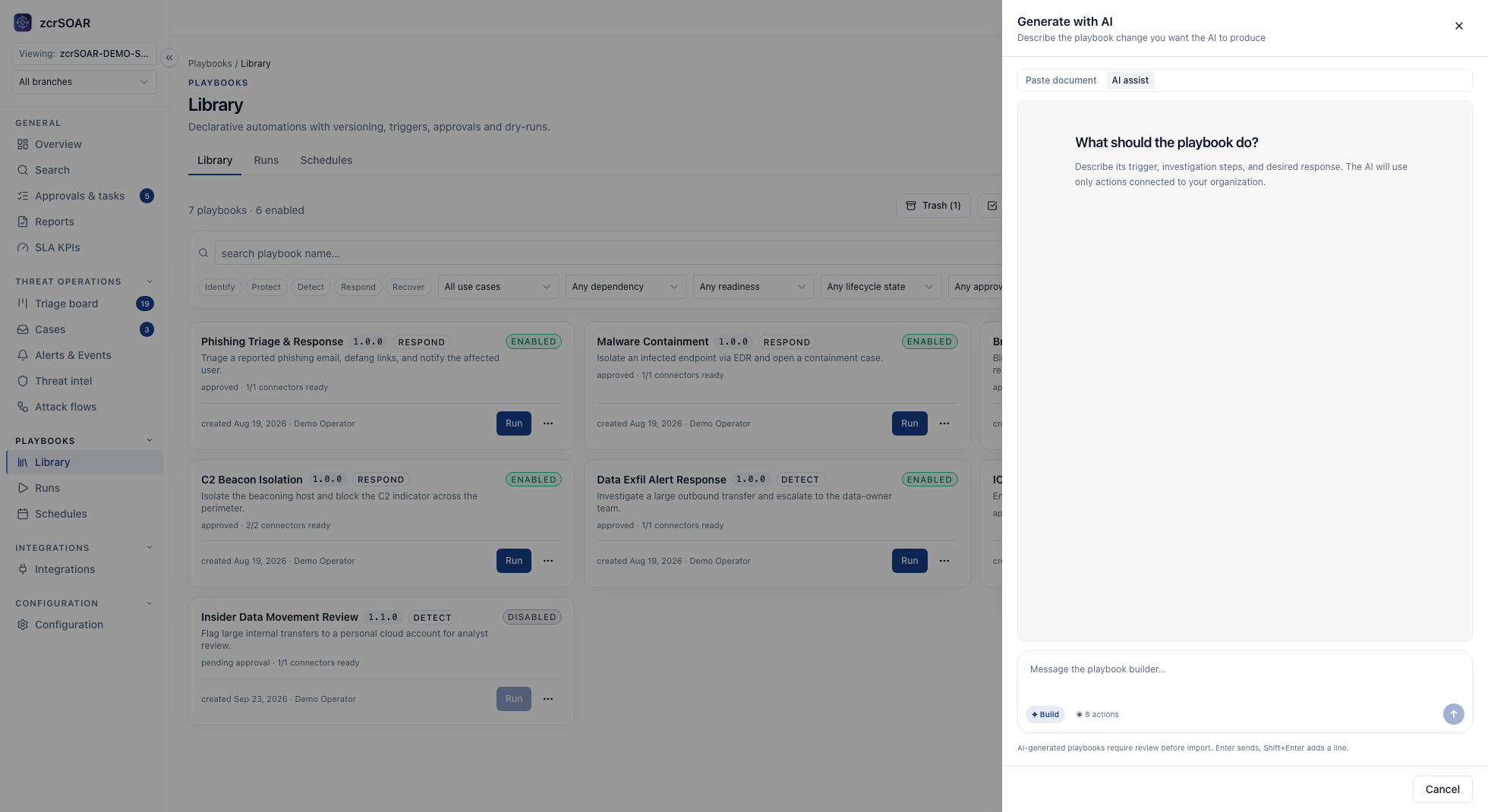
- zcrSIEM — AI translates plain language into queries — an analyst describes what they're looking for in a sentence, AI turns it into a query, and the analyst can review and edit the query before running it. See What Is AI-Assisted Threat Hunting? for details.
- zcrSOAR — automation with per-step gating — playbooks run automatically, and each step is set to Autonomous (runs immediately), Approval (waits for a role-gated sign-off) or Blocked (never runs until the gating changes). Which steps wait for a person is the customer's configuration. See How Agentic Automation Works in SOAR for details.
Together, these two layers are what "agentic AI in the SOC" actually looks like today — not AI replacing people entirely, but AI absorbing the high-volume work so people have time to focus on the decisions that actually matter.
Signs your organization is ready to look at agentic AI in the SOC
- Your team gets more alerts than people can genuinely keep up with
- You can't hire fast enough to fill SOC roles, or turnover keeps forcing you to retrain
- Analysts spend most of their time on repetitive work (writing queries, copying data between tools) rather than actual decisions
- You want to scale your security team, but the budget can't keep pace with how fast the threat volume is growing
If two or three of those sound familiar, zcrSIEM and zcrSOAR are the two platforms zcr built specifically to work together on this.
If you want to know how much agentic AI could help your current SOC team, check the zcrSIEM pricing against your team size and alert volume.
Get in touch
Curious how much agentic AI could help the SOC team you already have? Our team offers a free consultation.
Sources
- Check Point Software — Thailand press release, 11 September 2025 (via ThaiPR.NET) — reports an average of 3,201 weekly cyberattacks on Thai organizations in the first half of 2025 against a global average of 1,946
- ResearchAndMarkets — Thailand Managed Security Services Market Forecast and Competition Analysis Report 2025 — reports that, as of 2024, Thailand faced a gap of over 20,000 cybersecurity professionals; that 68% of managed security service providers report difficulty hiring qualified personnel and 56% cite high turnover from competition with global tech firms and banks; and a market forecast of USD 413.13 million in 2024 rising to USD 699.87 million by 2030 (9.02% CAGR)
Recommended pattern: a reviewable agent pipeline
If you are building or evaluating an AI agent for a SOC, a pattern worth following is a pipeline a person can review end to end: event → context → hypothesis → query → analyst review → approved action → audit record. Keep raw events, queries, tool calls and results separate from the model summary, and give every action typed inputs, a target scope, an approval state and an idempotency key, to help prevent duplicate or misdirected execution. This is general design advice, not a description of how any one product works.
To see what one such agent looks like (its loop, permissions and approvals), read What Is an AI SOC Agent? A Practical Guide for Security Teams; to choose how much autonomy to allow, see AI-Assisted SOC vs Autonomous SOC: Choosing the Right Operating Model.