zcrSOAR vs Cortex XSOAR, Splunk SOAR, IBM QRadar SOAR: A Real-World Comparison
zcrSOAR vs Cortex XSOAR, Splunk SOAR, IBM QRadar SOAR: pricing, deployment, integrations and where each competitor wins. 4 pricing tiers, no quote required.
zcrSOAR vs Cortex XSOAR, Splunk SOAR, IBM QRadar SOAR: A Real-World Comparison
Cortex XSOAR, Splunk SOAR, and IBM QRadar SOAR are usually the first three names a SOC team hears when the conversation turns to enterprise-grade SOAR. Each has a clear strength: XSOAR runs the biggest marketplace, Splunk SOAR plugs straight into the Splunk SIEM a lot of organizations already run, and IBM QRadar SOAR carries case-management roots built specifically for incident response. This article compares all three against zcrSOAR honestly — including the situations where each competitor is genuinely the better pick, not just the ones where zcrSOAR wins.
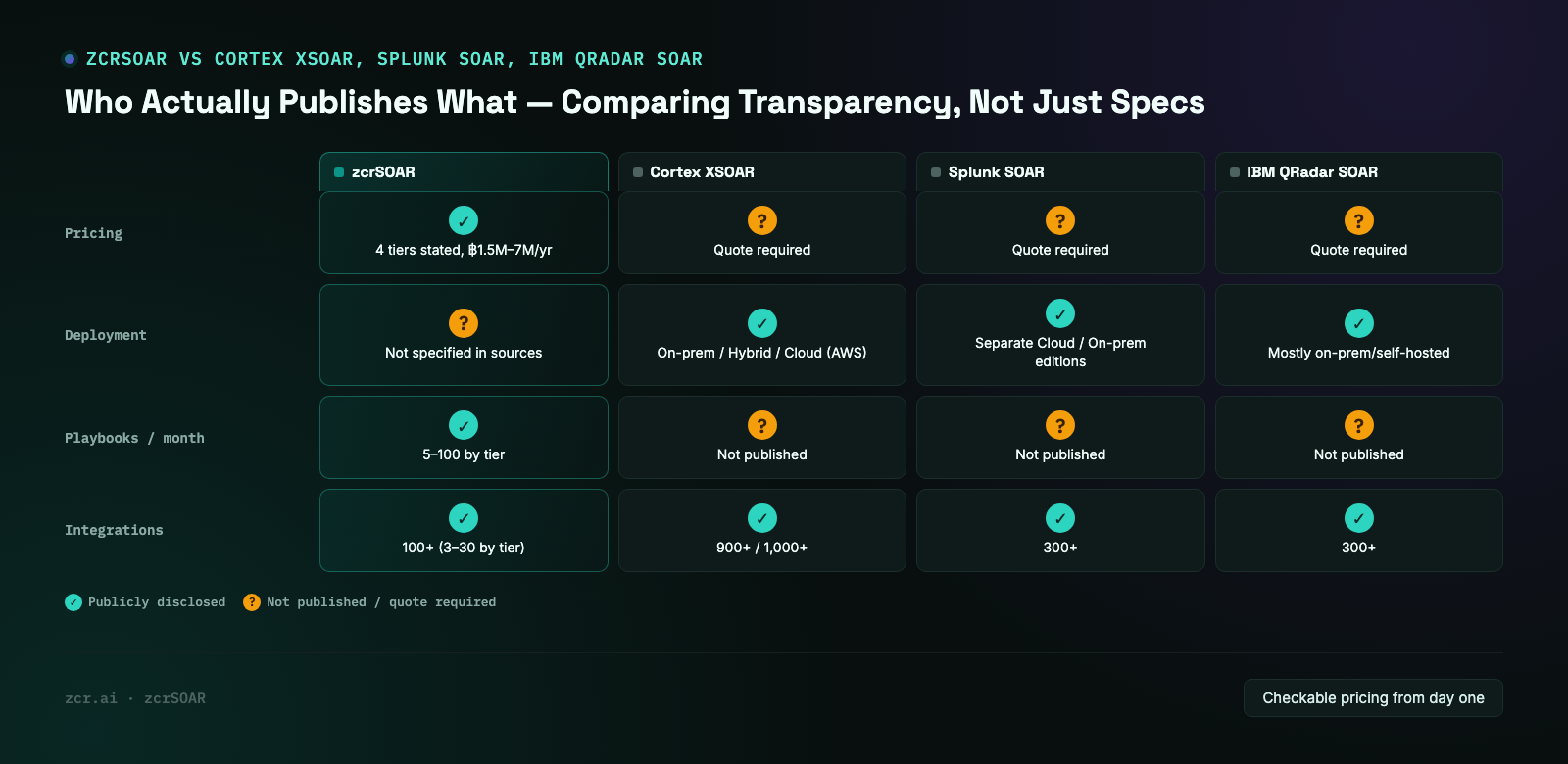
Quick Comparison
| zcrSOAR | Cortex XSOAR | Splunk SOAR | IBM QRadar SOAR |
|---|
| Price (publicly listed) | ฿1,500,000–6,960,000/yr on monthly billing (10% less if bought annually) across 4 clearly priced tiers | Not published — quote required. We could not find a reliably sourced third-party estimate for Enterprise-tier pricing | Not published — quote required. Splunk sells SOAR (Cloud) seats in increments of five, confirmed in Splunk's own licensing documentation, but we couldn't trace a specific, checkable public procurement figure back to a real record, so we're not quoting one here — no reliable general per-seat or enterprise range is publicly available either way | Not published — quote required. We found no reliable third-party estimate for QRadar SOAR pricing |
| Deployment | Not specified | On-prem, hybrid (cloud server + on-prem engine), or cloud SaaS (you pick a host region from the list in Palo Alto's documentation) | Separate Cloud and On-premises editions, licensed apart from the core Splunk platform | Mostly on-prem/self-hosted (virtual appliance or software on OpenShift/VMs) — the SaaS variant was sold to Palo Alto, which announced its EOL effective April 14, 2026 |
| Integration count | 100+ listed in the connector catalog, but the number of integrations actually purchasable/active per tier is 3 / 8 / 15 / 30 (Starter/Standard/Enterprise/MSSP) — we don't have a documented explanation for the gap between "100+" and the tier caps, so treat the tier numbers as what you actually get | 850+ integrations per Palo Alto's current marketplace figure; G2 separately cites 270+ ready-made playbooks across 350+ third-party products | 350+ tools, 2,800+ ready-made automated actions | 300+ bidirectional integrations |
| Playbooks / automation per month | 5–100 playbooks by tier, 500–50,000 automation runs/month by tier | Not published | Not published | Not published |
| Support / SLA | Business hours on the two lower tiers; 24x7 / 12x7 SLA on the two upper tiers, per the published pricing table | Not published | Not published | Not published |
💰 See all 4 zcrSOAR pricing tiers — no quote required →
Where the Competitors Genuinely Win
Cortex XSOAR: the largest ecosystem of the three
- Biggest marketplace of the three compared here — 850+ integrations per Palo Alto's current marketplace figure; G2 separately cites 270+ ready-made playbooks across 350+ third-party products. However you count it, this is a larger ecosystem than Splunk SOAR (350+ tools) or QRadar SOAR (300+ integrations) — though these vendor-reported counts aren't measured on identical units, so treat "biggest" as directional rather than an exact ranking. Palo Alto's own marketplace page says XSOAR is the only SOAR platform that vets all free and paid third-party marketplace content as safe for immediate use.
- FedRAMP High Authorization — Cortex (the platform XSOAR sits under) earned this authorization in January 2025, which Palo Alto describes as a first for an AI-driven SOC platform. That opens U.S. federal/government deals a regional SOAR player like zcrSOAR isn't positioned to compete for.
- Deeper ties into a wider ecosystem — Cortex XSIAM/XDR, Palo Alto NGFW, Prisma. If your organization has already standardized on Palo Alto, consolidating everything under one vendor has real logic behind it.
- Longest SOAR pedigree of the three — inherited from Demisto, one of the category's pioneers, with years of accumulated analyst mindshare and training ecosystem behind it.
Splunk SOAR and IBM QRadar SOAR: the real edge when you're already tied to their SIEM
- Splunk SOAR integrates natively with Splunk Enterprise Security — for the many organizations already running Splunk as their SIEM/observability platform, that's a genuine, tangible advantage over a SOAR that's bolted on afterward (though Splunk itself notes the SOAR license is separate from the core platform and doesn't require ES as a prerequisite). Add Splunkbase — a large, long-established app ecosystem in security tooling — plus an App Editor and Logic Loops that let teams with SPL skills extend things deeply using knowledge they already have.
- IBM QRadar SOAR carries the longest incident-response-specific pedigree of the three — inherited from Resilient Systems, which IBM acquired in 2016, a case-management pioneer from before "SOAR" was even a category name. It ties deeply into IBM's much larger portfolio (X-Force threat intelligence, Guardium, ITSM/DevOps tooling), is backed by IBM Consulting's global MSSP network for large multi-region deployments, and comes with an award-winning Playbook Designer plus a long-established Global 2000 customer base.
Where the Hidden Costs Are
- Undisclosed pricing means going through a full sales process — none of the three publish a pricing page, and we couldn't find reliably sourced third-party estimates for any of them either (the handful of numbers floating around review sites didn't hold up when we tried to trace them back to an actual source). The closest we found to a real data point was a public procurement record showing five Splunk SOAR cloud seats at roughly $248,735/yr — one configuration, not a general range. Your actual budget depends on negotiation, not a checkable list price, unlike zcrSOAR, where all 4 tiers have been publicly priced from day one.
- Module structures that split across separate quotes — Cortex XSOAR sells Threat Intelligence Management (TIM) both as a standalone add-on SKU and as a capability integrated into the wider XSOAR platform — we couldn't confirm a single current rule for which tier includes it bundled versus billed separately, so check exactly what's in the quote you're given. IBM QRadar SOAR splits into two modules too: Case Management (available by default) and Orchestration & Automation (its own license) — meaning if you actually want automation, not just case tracking, that's another line item on the contract.
- Deployment constraints that might not match your plans — IBM QRadar SOAR's SaaS tier was sold to Palo Alto as part of the broader QRadar SaaS asset deal that closed September 4, 2024, and Palo Alto set April 14, 2026 as the EOL date for that acquired SaaS product (End-of-Sale, April 14, 2025, was the earlier milestone, not the EOL date itself). That EOL date has passed, so the SaaS variant is no longer an option; the on-prem/software edition wasn't part of the sale.
- The native-SIEM advantage doesn't help if you're not already using that SIEM — Splunk SOAR's core selling point is tighter integration with Splunk Enterprise Security than a bolted-on SOAR, and IBM QRadar SOAR's is pulling QRadar offenses straight in as incidents. But if your organization isn't already running Splunk ES or QRadar SIEM, that headline advantage does nothing for you — you'd be paying enterprise SOAR pricing for a benefit you can't actually use.
Who zcrSOAR Fits
zcrSOAR is built to run standalone — it sits directly on top of the firewall, endpoint, and identity/AD tools you already have, no SIEM required first. That's the opposite of what makes Splunk SOAR or IBM QRadar SOAR compelling, since their core advantage comes from being tied to a SIEM from the same vendor. It fits SOC teams, MDR providers, MSSPs, IT security operations teams, and compliance-driven teams particularly well. The MSSP Edition (100 playbooks, 50,000 automation runs/month, 30 integrations, multi-tenant RBAC, white-label reports) is built specifically for providers managing multiple tenants at once, and compliance-driven teams benefit from immutable monthly evidence reports — checksum-backed and tamper-evident — a feature built into zcrSOAR alongside attack flow visualization mapped to MITRE ATT&CK, so investigators can trace technique IDs against the standard. For a concrete example of what that automation looks like in practice, see how to build a phishing response playbook your team doesn't have to run by hand.
The Straight Answer
If your organization is already inside the Palo Alto ecosystem (Cortex XDR/XSIAM, NGFW, Prisma) or needs FedRAMP High compliance for U.S. federal work, Cortex XSOAR is likely the better fit. If you're already running Splunk Enterprise Security or QRadar SIEM with a team that knows the platform, staying with the same vendor's SOAR makes sense too, because the tighter native integration is real, not marketing.
But if you're a SOC or MSSP team that needs a SOAR platform that stands on its own — no SIEM or full XDR platform required as a prerequisite — that wants firm pricing from day one instead of waiting on a quote that could land anywhere from the low hundreds of thousands to millions of baht, and that needs audit-ready evidence reports out of the box, zcrSOAR is the better fit.
⭐ Try zcrSOAR Yourself
zcrSOAR — a SOAR platform covering everything from alert triage and playbook automation to role-based approval workflows and immutable, audit-ready evidence reports.
🎯 Try the free demo →
📞 Free Consultation
Sources
- Palo Alto Networks — Cortex achieves FedRAMP High Authorization, accessed 2026-09-15.
- Palo Alto Networks — Cortex XSOAR Marketplace (850+ integrations), accessed 2026-09-15.
- G2 — Cortex XSOAR reviews and product data, accessed 2026-09-15.
- Palo Alto Networks — Cortex XSOAR 8 SaaS: supported host regions, accessed 2026-09-25.
- Palo Alto Networks — Threat Intel Management overview, accessed 2026-09-15.
- Splunk — SOAR features and automation catalog, accessed 2026-09-15.
- Splunk — pairing Enterprise Security with Splunk SOAR, accessed 2026-09-15.
- Splunk — SOAR licensing documentation, accessed 2026-09-15.
- IBM Community — QRadar SOAR surpasses 300 apps on the App Exchange, accessed 2026-09-15.
- SolutionsReview — IBM's Resilient Systems acquisition history, accessed 2026-09-15.
- IBM Docs — accessing Case Management and Orchestration & Automation, accessed 2026-09-15.
- Palo Alto Networks — closes acquisition of IBM's QRadar SaaS assets, accessed 2026-09-15.
- Palo Alto Networks — EOS/EOL datasheet for acquired threat management SaaS products, accessed 2026-09-15.