zcrADC vs F5 BIG-IP, Citrix NetScaler, A10 Networks: A Straight Comparison
zcrADC vs F5 BIG-IP, Citrix NetScaler and A10 Networks: throughput, DDoS mitigation, certifications and pricing compared, with a straight answer on who fits.
F5 BIG-IP, Citrix NetScaler, and A10 Networks aren't lightweight competition — all three have been fixtures in the Application Delivery Controller (ADC) market for decades. F5 was named a Leader in Gartner's Magic Quadrant for ADC for 10 consecutive years while that report still existed. Citrix NetScaler first launched in 1997, ahead of A10 (founded 2004) — though not ahead of F5, which was founded in 1996 and shipped BIG-IP the following year, in 1997. A10, meanwhile, built its foundation in the telco market, where handling traffic in the hundreds of Gbps is just another day at the office.
This article compares zcrADC against all three, honestly — including where the competition genuinely wins. Nearly every number here comes straight from official documentation on both sides (the zcrADC_Brochure_v1.0.3 for zcr, and each competitor's referenced datasheet or official material) — the few exceptions, like third-party support-cost and reseller-pricing estimates, are labeled as such rather than presented as vendor-official. Wherever a number isn't publicly disclosed, we say "not disclosed" instead of guessing or borrowing a figure from a comparable product.
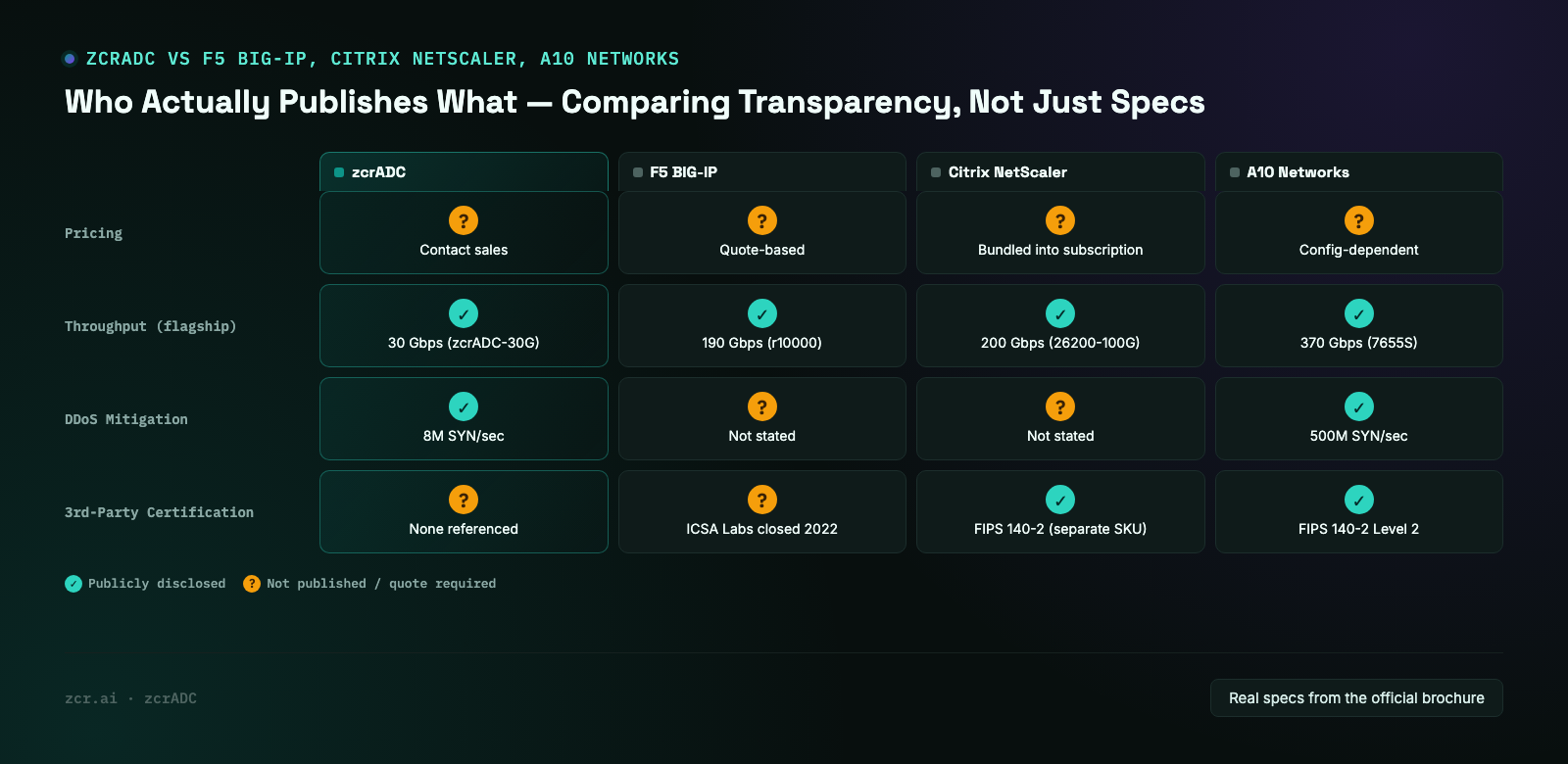
Specs at a Glance
The table below compares the highest-tier model each vendor publishes specs for — zcrADC-30G (the top of the Hardware/Virtual Appliance line) against F5's flagship (r10900, part of the r10000 platform family), Citrix's (MPX/SDX 26200-100G), and A10's (Thunder 7655S ADC). All three competitor flagships are built for telco/hyperscale workloads, while zcrADC-30G, per its own brochure, targets small-to-large enterprise customers — not telco scale. The multi-fold gaps in this table reflect a difference in target market, not zcrADC "losing" across every dimension of real-world use.
The units aren't perfectly consistent across vendors either — some report SSL TPS, some report SSL CPS, and some don't publish SSL bulk throughput at all. This table keeps each vendor's own published units rather than forcing them into one standard.
| Item | zcrADC-30G | F5 BIG-IP r10900 | Citrix NetScaler MPX/SDX 26200-100G | A10 Thunder 7655S ADC |
|---|
| Deployment model | Cloud (SaaS) / Virtual Appliance / Hardware Appliance | Hardware (F5OS rSeries) / Virtual VE / F5 Distributed Cloud (SaaS) | Hardware (MPX) / Multi-tenant (SDX) / Virtual VPX / Cloud | Bare metal / Virtual (vThunder) / Container / Cloud |
| Public pricing | Not disclosed — contact sales | Not disclosed — quote-based (third-party pricing research confirms a quote-only model) | Not disclosed — NetScaler entitlement is now bundled primarily into Citrix's overall subscription packages | Not disclosed — depends on capacity/configuration, quote required |
| Max Throughput (L4/L7) | 30 Gbps (combined L4/L7) | 190 Gbps / 190 Gbps | 200 Gbps (L7 system) | 370 Gbps / 340 Gbps |
| SSL/TLS Bulk Throughput | 18 Gbps | 95 Gbps | 60 Gbps (dedicated SSL) | 145 Gbps |
| SSL TPS/CPS (RSA 2K) | Not specified | 200,000 TPS | 125,000 TPS | up to 200,000 SSL CPS (dual-SSL-option max) |
| L4 Connections/sec | 800,000 CPS | 2,500,000 conn/sec | Not specified (only 5,500,000 L7 requests/sec published) | 12,000,000 L4 CPS |
| DDoS Protection (SYN flood) | 8 million SYN/sec | Not specified | Not specified | up to 500 million SYN/sec (dual-DDoS-option max) |
| Form factor | 1RU | 1RU | 2U | ~1.5U |
| Third-party certification | No referenced certification | BIG-IP's web application firewall previously held ICSA Labs certification, but ICSA Labs shut down in 2022, so it can no longer be cited as a currently maintained certification | FIPS 140-2 certified SKU available as a separate product line | FIPS 140-2 Level 2 certified models available |
On pricing — none of the four vendors publish list prices. That's not a weakness unique to zcrADC; it's standard practice across the entire enterprise ADC/load-balancer category. Anyone comparing prices between these four has to request a quote from each one directly — you can see plan details and request a zcrADC quote right now.
Where F5, Citrix NetScaler, and A10 Networks Actually Win
This section isn't a formality — all three have real advantages buyers should know before deciding.
Brand pedigree and a proven track record. F5 was named a Leader in Gartner's Magic Quadrant for ADC for 10 consecutive years while the report existed — a streak no newer player catches up to quickly. Citrix NetScaler launched in 1997 and shipped its first load balancer in 2001, predating A10 (though not F5, which was already in the market by 1997 too), and Ferroque Systems, a Citrix-focused consultancy, has called it "the most battle-tested ADC appliance on the market" — a partner's opinion worth knowing, not an independent analyst verdict. A10, for its part, spent years building specialized DDoS and high-volume traffic experience in the telco market (CGNAT, 5G gateways). That kind of proven track record at large-enterprise scale takes real time to build for any newer vendor — there's no shortcut.
A raw hardware performance ceiling. The numbers in the table above speak for themselves — F5's r10900 at 190 Gbps, Citrix's 26200-100G at 200 Gbps, and A10's 7655S at 370 Gbps are all telco/hyperscale-grade specs that zcrADC-30G (30 Gbps) simply doesn't reach yet. Even F5's "entry-level" r4000-series delivers 50/40 Gbps (L4/L7) — still higher than zcrADC's top tier. A10's 500-million-SYN/sec DDoS figure comes from real-world experience absorbing the scale of attack traffic telecom carriers actually face — the kind of number that only becomes credible after years of proving itself at real, large-scale volume.
A deeper ecosystem and more specialized integrations. F5's scripting and automation tooling has been accumulating for two decades — iRules dates back to 2004, with iApps (2011) and iCall added later — giving it far more scripted use cases and partner tooling than a regional vendor can match in a short time. Citrix NetScaler integrates with Citrix Virtual Apps and Desktops (ICA/HDX proxy, SSO, gateway) so deeply that every hardware model's datasheet lists a dedicated ICA Proxy/SSL VPN concurrent-user spec line (the 26200-100G supports 20,000 concurrent users) — a clear sign NetScaler was built as a purpose-built VDI front door, not just a generic load balancer. A10, meanwhile, runs a single ACOS operating system across every form factor (bare metal, VM, container, cloud) with centralized management through A10 Harmony — that kind of cross-platform codebase consistency takes years to build.
Cross-cloud deployment flexibility. All three have an official presence on public cloud marketplaces — F5 offers VE on AWS/Azure/GCP plus F5 Distributed Cloud as a SaaS layer; Citrix offers VPX on the AWS/Azure/GCP marketplaces with pooled-capacity licensing that lets one subscription move between on-prem, VPX, and cloud at a constant price; A10 offers vThunder as a native image on the AWS, Azure, and Oracle Cloud marketplaces. That "move your license across deployment modes without buying again" capability is a model smaller vendors running simple per-appliance licensing usually don't have yet.
The Costs That Don't Show Up in the Quote
Needing a quote isn't just about vendors withholding a number — each one carries its own hidden costs beyond the sticker price.
For F5, procurement platform Vendr estimates that beyond hardware capex, annual support typically runs around 17-22% of contract value — a third-party estimate rather than an F5-published figure, but a real ongoing cost to budget for beyond the price at purchase. And its old ICSA Labs certification can no longer be cited, since the organization shut down in 2022 — we didn't find a current, actively maintained third-party WAF performance certification for F5 as a replacement, though we can't rule one out.
For Citrix NetScaler, the bigger issue is that entitlement is bundled into Citrix's overall subscription package rather than sold as a clearly separate ADC product — meaning the real cost depends on how much of the Citrix ecosystem your organization decides to buy, not just an ADC purchase decision on its own. Pricing figures floating around on reseller sites or old GSA schedules (roughly $670 to $50,000+ per SKU) span too wide a range to treat as a reliable current number — a direct quote is the only way to know the real figure.
For A10 Networks, there's no official list price, though scattered public data points exist — user-reported historical prices on PeerSpot and hourly usage pricing for A10's AWS Marketplace listings — none of which reliably substitute for a quote scoped to your actual configuration.
And there's one hidden cost that applies to all three — the cost of buying more than you need. All three flagship models are built for telco/hyperscale workloads. If a mid-sized organization buys an r10900, a 26200-100G, or a 7655S, it's paying capex and licensing tied to 190-370 Gbps of capacity it will almost certainly never touch. That's especially true for Citrix, given how deeply it's tied to ICA/HDX proxy — if your organization isn't already a Citrix VDI shop, that whole slice of the spec sheet is capability you paid for and won't use.
zcrADC has its own honest gaps too — the brochure doesn't reference any third-party performance certification the way Citrix and A10 do (FIPS 140-2), and the depth of the bundled WAF (rule count, or OWASP coverage) isn't documented to the same level of detail as the standalone zcrWAF product, which explicitly states OWASP Top 10 coverage. If your organization needs FIPS-certified crypto modules or detailed WAF rule-coverage documentation upfront, ask your channel partner before deciding.
Who zcrADC Is Really Built For
The zcrADC brochure defines its target market clearly, by deployment mode: Cloud (SaaS) and Virtual Appliance target small-to-mid-size organizations, while the Hardware Appliance line covers small through large enterprises across three tiers (2G/15G/30G), so you pick based on the throughput you actually need — no overbuying required.
Organizations that want L4/L7 load balancing bundled with WAF, API Protection, and DoS/DDoS protection in a single box; that need to integrate with existing authentication via LDAP/Active Directory/RADIUS/SAML; and that want a real-time dashboard showing virtual services, traffic, and security events on one screen — with live throughput, connection counts, and WAF status at a glance — that's exactly who zcrADC was built for. Not telco-scale workloads that need 190-370 Gbps.
See the full feature list and specs on the zcrADC page.
The Straight Answer
If your organization genuinely needs 100+ Gbps throughput — you're a telecom carrier, a hyperscale data center, or facing massive DDoS risk that needs hundred-million-SYN/sec mitigation — F5, Citrix, or A10 is honestly the right answer, because all three flagships were purpose-built for that scale, and zcrADC-30G at 30 Gbps / 800K CPS simply isn't designed for it. Likewise, if your organization is already running Citrix Virtual Apps and Desktops and wants ICA/HDX proxy integration documented down to the hardware datasheet level — NetScaler is genuinely the better fit. No argument there.
But for most Thai organizations, whose real requirement is reliable L4/L7 load balancing with WAF, API Protection, and DDoS protection in a single box — without paying for telco-scale capacity they'll never use, and with a clear quote from a channel partner — zcrADC was built specifically for that group. It's not a stripped-down version of someone else's product.
Ready to See More?
See all the features and specs for zcrADC, or check plans and request a quote directly.
Contact us
Sources
- F5 — named a Leader in Gartner Magic Quadrant for ADC, 10th consecutive year, accessed 2026-09-15.
- Wikipedia — NetScaler company history, accessed 2026-09-15.
- F5 Community — history of F5 (BIG-IP ship date), accessed 2026-09-15.
- A10 Networks — Thunder ADC datasheet (company history, hardware specs), accessed 2026-09-15.
- F5 — rSeries Appliance data sheet (r10900, r4000 series specs), accessed 2026-09-15.
- Citrix — Citrix ADC datasheet (MPX/SDX 26200-100G specs), accessed 2026-09-15.
- TelecomLead — F5 certified firewall protects against large-scale cyber attacks on public-facing websites (27 January 2012) — says F5 already held ICSA Labs certifications for its BIG-IP web application firewall, accessed 2026-09-25.
- Wikipedia — International Computer Security Association (ICSA Labs) — says ICSA Labs ceased operation in 2022 after Verizon closed it, accessed 2026-09-25.
- Citrix documentation — NetScaler MPX FIPS-certified appliances, accessed 2026-09-15.
- NIST CSRC — A10 Thunder Series FIPS 140-2 Level 2 security policy, accessed 2026-09-15.
- BusinessWire — F5 iApps announcement (2011), accessed 2026-09-15.
- A10 Networks — Advanced Core Operating System (ACOS), accessed 2026-09-15.
- Citrix documentation — VPX pooled capacity licensing, accessed 2026-09-15.
- Oracle Cloud Marketplace — A10 vThunder listing, accessed 2026-09-15.
- Vendr — F5 pricing and support-cost benchmark, accessed 2026-09-15.