What Is OWASP Top 10? How a WAF Blocks Each Attack Type
OWASP Top 10:2025 covers the attack patterns web apps face most often. See what each category looks like in practice and exactly how a WAF blocks each one.
What Is OWASP Top 10? How a WAF Blocks Each Attack Type
"Credential Stuffing" and "Path Traversal" — this article describes how these patterns show up in a WAF's Attack Logs. It quotes no customer telemetry, no real incident and no numbers read off the demo. It explains the OWASP Top 10:2025 context and what a WAF may detect; nothing here should be read as real attack statistics.
This piece walks through what OWASP Top 10 is, and how a WAF catches and blocks each category.
What is OWASP Top 10
OWASP (Open Web Application Security Project) is a nonprofit that tracks the most common web application vulnerabilities worldwide and ranks them into a "Top 10," refreshed every 2-3 years based on real attack data collected from thousands of organizations — a shared baseline that security and dev teams reference globally.
The categories that show up most often, and that a WAF blocks directly:
- SQL Injection — inserting SQL commands through an input field to read or modify database data without authorization
- Cross-Site Scripting (XSS) — injecting malicious JavaScript into a page to steal another user's session or data
- Broken Access Control — reaching data or functionality that should be restricted, by tampering with a parameter or URL directly
- Path Traversal — using a pattern like
../../ to reach files outside the directory that should be accessible
- Credential Stuffing — taking email/password lists leaked from other breaches and trying them against a target system, betting that some users reuse passwords
What zcrWAF's Attack Logs show
Here's how each entry reads on the zcrWAF demo's Attack Logs over the past 7 days:
Every entry carries the attack type (for example Credential Stuffing or Path Traversal), a severity, the WAF mode (for example Protected), the source IP and its country, the domain that was targeted, how many hits were counted, first-seen and last-seen times, and a status.
The hit count is the column to read first. A high count from a single source in a short window is what credential stuffing and path-traversal scanning usually look like: repeated, machine-fast requests, not a real user fumbling a few typos.
How a WAF blocks each attack type
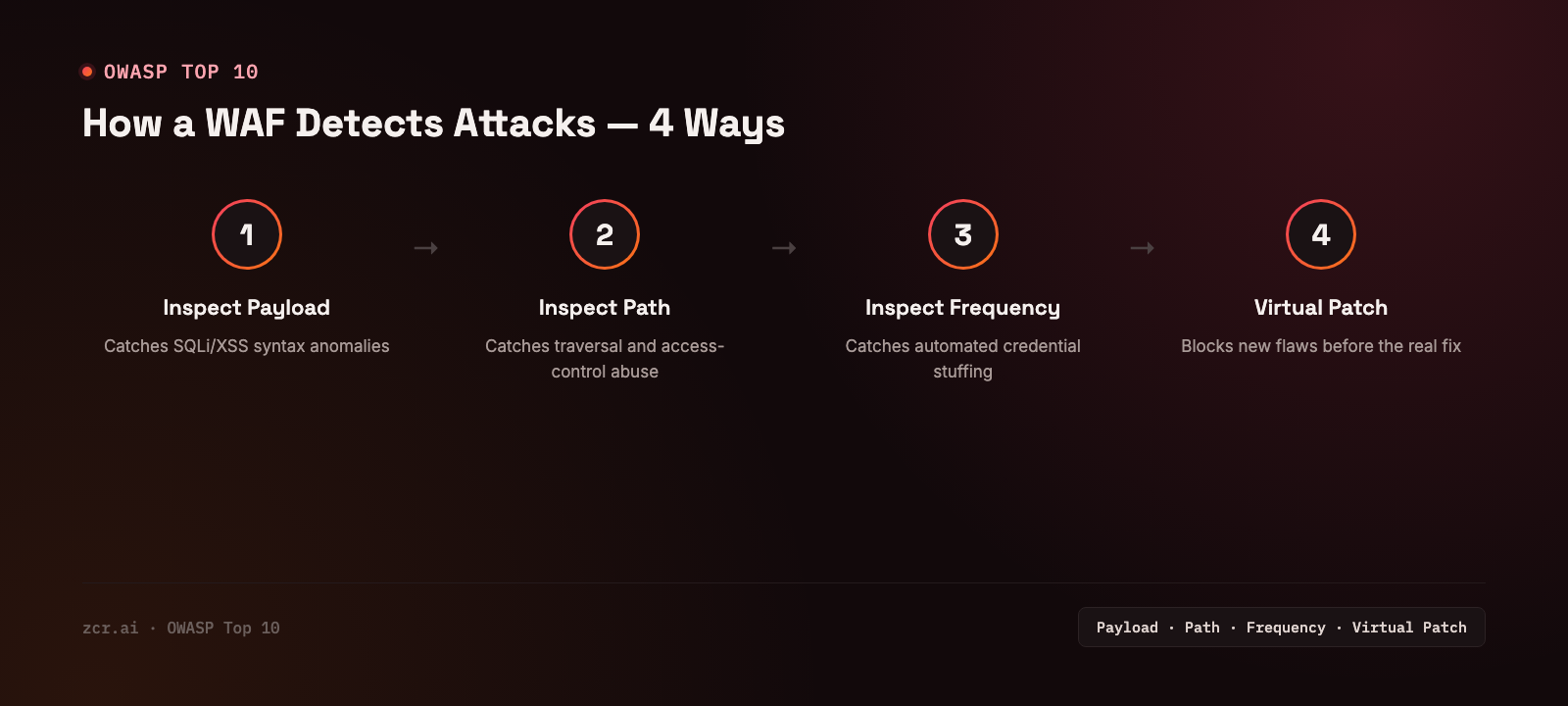
1) Inspect payload patterns — SQL injection and XSS payloads usually carry syntax that looks abnormal for normal input (characters like ', --, <script>). A WAF matches against known signatures and unnatural behavior.
2) Inspect the requested path and parameters — path traversal and broken access control attempts usually reach for paths or parameters outside a site's normal usage pattern.
3) Inspect request frequency and pattern — credential stuffing and vulnerability scanning tend to arrive as repeated, machine-fast bursts unlike normal human behavior. This connects directly to rate limiting (see Stopping Bots and Layer 7 DDoS with a WAF).
4) Match against pre-built attack-pattern rule templates — common attack shapes (SQLi, XSS, path traversal, and more) get blocked by ready-made rule templates without writing custom rules from scratch.
Signs your website is already facing this kind of attack
- You've seen failed logins spike sharply in a short window (a credential stuffing signal)
- You're seeing 404s or 403s on strange paths that don't match your actual site structure (a path traversal/scanning signal)
- There's no log that distinguishes attack traffic from real users
- Your site holds customer data and you've never checked whether it's already faced OWASP Top 10-style attacks
Understanding OWASP Top 10 is the starting point for web protection — see the full picture in What Is a WAF?
How zcrWAF closes these gaps
zcrWAF covers OWASP Top 10 and other common web attack patterns through pre-built rule templates, with real-time logs that auto-classify attack types (as seen in the Attack Logs above).
If you want to know whether your website has already faced OWASP Top 10-style attacks, check the zcrWAF pricing.
Get in touch
Want to know if the website you manage has already been targeted by OWASP Top 10-style attacks? Our team offers a free consultation.
Sources
- OWASP Foundation, “OWASP Top Ten Web Application Security Risks” — current project status and OWASP Top 10:2025 reference: https://owasp.org/www-project-top-ten/ (accessed September 14, 2026)
- Data note: this article quotes no numbers or events from the demo or from customer telemetry; the Attack Logs section describes the fields that page shows