External Attack Surface: The Blind Spot Attackers Find Before You Do
Attackers map your exposed assets before they ever touch your network. External Attack Surface Management closes that blind spot before they find it first.
External Attack Surface: The Blind Spot Attackers Find Before You Do
Before a burglar breaks into a house, they don't walk straight through the front door. They circle the block first — which window doesn't latch properly, where the back fence has a gap, how many days of mail have piled up in the box. All of that recon happens without ever touching the house, just by standing on the street and looking.
Cyberattacks start the same way. The first thing an attacker does is recon — mapping out everything an organization has exposed to the internet, without breaking anything yet. Just scanning, searching, and cataloging domains, subdomains, APIs, and certificates that face the outside world. The problem is most organizations never do this recon on themselves first — the attacker usually does it before they do.
External Attack Surface Management (EASM) is doing that recon on yourself, continuously, before anyone else gets the chance.
Why the full attack surface stays invisible
Most IT teams know the assets they built and manage. The real gap is everything that never made it into that inventory:
- Shadow IT — marketing signs up for a landing-page tool on its own; sales spins up a demo environment without looping in IT at all
- Forgotten old domains — a campaign that ended two years ago, but the subdomain still points to a server nobody's patched since
- APIs left open from testing — a developer opens a test endpoint, ships the real one, and forgets to close the first
- Certificates expiring or already expired — this isn't just a broken-padlock icon in a browser; an expired cert is usually a sign nobody's actively maintaining that asset, which tends to travel with other unpatched issues
- Cloud storage misconfigured as public — an S3 bucket or similar that should've been private from day one, but wasn't
What all of these share is that they never show up in the asset list security looks at every day. They get discovered when something's already gone wrong.
How EASM finds your attack surface — 4 steps
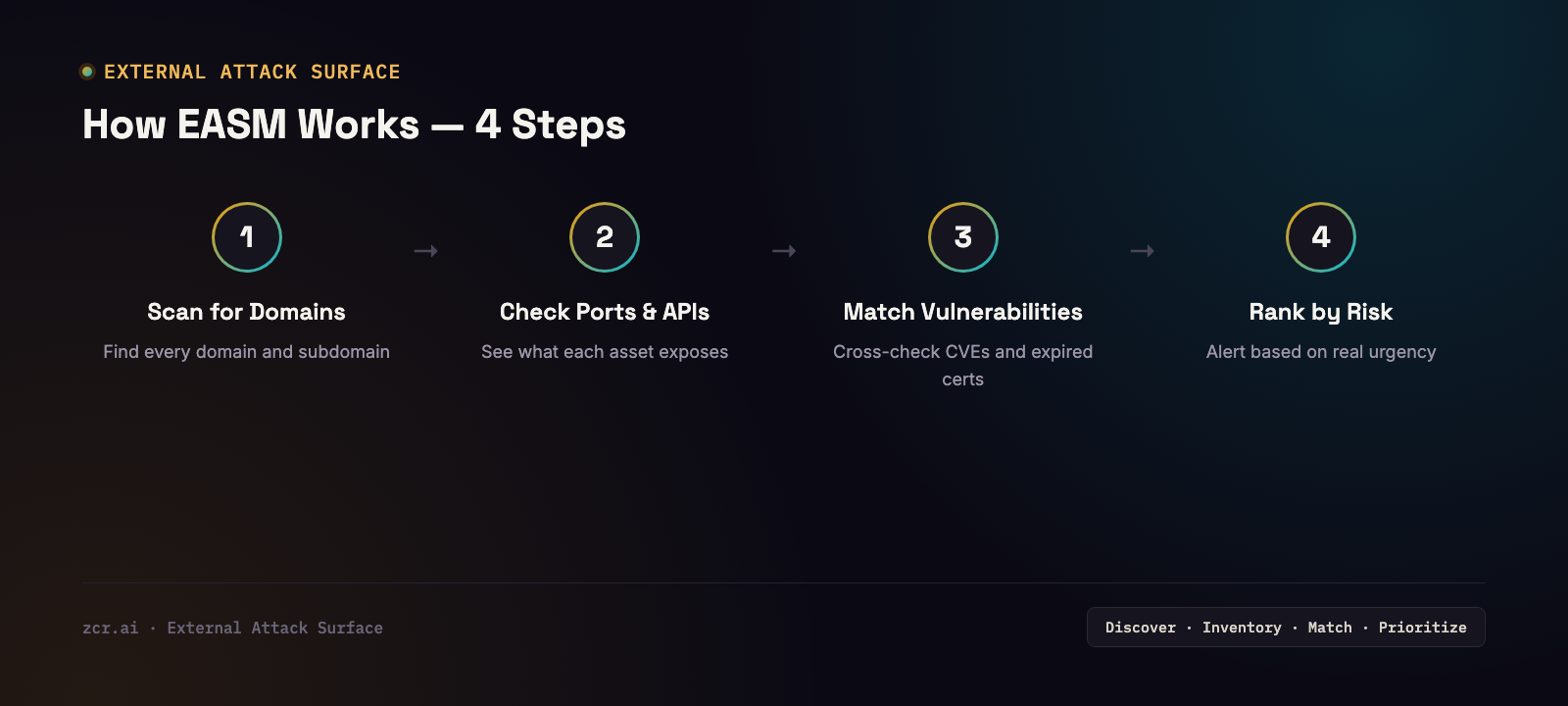
1) Scan for domains and subdomains — discover every domain tied to the organization, including subdomains nobody documented, using the same techniques attackers use (certificate transparency logs, DNS enumeration, cross-cloud-provider search).
2) Check open ports, services, and APIs — see what each asset actually exposes to the outside, including undocumented shadow APIs.
3) Match against known vulnerabilities — cross-reference each asset's software version against known CVEs, and flag certificates that are expiring or already expired.
4) Rank by risk and alert — not every finding is equally urgent; prioritize by how critical the asset is and whether the vulnerability is actually exploitable.
What this looks like in zcrCTEM's EASM view
The zcrCTEM demo's EASM page tracks internet-facing assets by severity, plus how many are newly discovered in the last window — which is exactly why a one-time scan doesn't cut it: attack surface shifts week to week, not quarter to quarter. The demo runs on sample tenant data, so treat this as a description of what the view tracks, not a specific count.
Certificates are another blind spot the same view watches: expiring-soon and already-expired certificates — early warning signs you can catch before they become an actual outage, instead of finding out when a customer calls about a browser warning.
Signs your organization needs EASM
- You've discovered a subdomain or old system still running that nobody knew about (usually after it caused a problem)
- There's no up-to-date list of everything your organization exposes to the internet
- Departments outside IT regularly spin up their own SaaS tools or landing pages without telling anyone
- Your site or app has hit a surprise certificate warning before
- You operate multiple branches or brands, making it hard to know whether every one of them is actually being watched
Seeing your full attack surface is the starting point of CTEM — read the full picture in What Is CTEM? if you want to see how EASM connects to the bigger risk-management cycle.
How zcrCTEM closes this gap
zcrCTEM runs EASM continuously, not as a one-time scan — automatically discovering new assets (configurable from hourly to daily), matching them against known vulnerabilities, and ranking risk with an RSC score that blends CVSS, EPSS, KEV/exploited status, attack-path context, and internet exposure — not a raw CVSS number. It also connects to Digital Risk Protection so you can see whether a discovered asset has related leak signals tied to it.
If you want to know how much of your attack surface is currently invisible, check the zcrCTEM pricing.
Get in touch
Want to know how many exposed assets your organization has without realizing it? Our team offers a free consultation.
Sources