What Is SOAR? — When Your SOC Can't Keep Up With Alerts by Hand
What is SOAR, and how is it different from SIEM and SOC? A plain-English breakdown of how Security Orchestration, Automation and Response actually works.
What Is SOAR? — When Your SOC Can't Keep Up With Alerts by Hand
Picture an ER where patients keep walking in nonstop. If every doctor had to take notes, dig through paper files, and call the lab manually for every single case, even the best doctor in the world would fall behind. Real emergency rooms run on protocol instead — nurses triage on sight, lab requests fire automatically, and there's a clear rule for which cases need a doctor's sign-off before anything happens.
A SOC (Security Operations Center) runs into the exact same wall. Alerts show up by the hundreds or thousands a day, and if analysts have to open every single one, copy data between tools by hand, and make every call themselves — the backlog wins. SOAR is the "ER protocol" version of a SOC.
What SOAR Stands For
SOAR = Security Orchestration, Automation and Response — three layers of what it actually does:
- Orchestration — connects the security tools your team already has (firewall, EDR, identity, SIEM) so they work together in one place instead of forcing analysts to jump between screens
- Automation — runs the repetitive steps on its own: pulling IOC data to enrich a case, blocking an IP once it's confirmed malicious, notifying the right people
- Response — tracks every case from open to close, with an approval step built in before anything high-impact (isolating a machine, disabling an account) actually happens
How SOAR Differs From SIEM and SOC
The most common confusion is that SOAR, SIEM, and SOC sound alike but do different jobs — we covered this in more depth in Log Management vs SIEM vs SOC. The short version:
| What it does | The question it answers |
|---|
| SIEM | Collects and correlates logs from multiple sources, then flags anomalies | "What happened?" |
| SOC | The people and process watching and deciding | "Who's responsible, and how do they decide?" |
| SOAR | The system that lets the SOC team actually respond fast and consistently | "How do we respond quickly without dropping the ball?" |
Put simply: SIEM tells you something's wrong. SOAR picks up from there and answers "now what?" The two work as a pair — most organizations with a mature SOC run both side by side.
How SOAR Actually Works — 4 Core Pieces
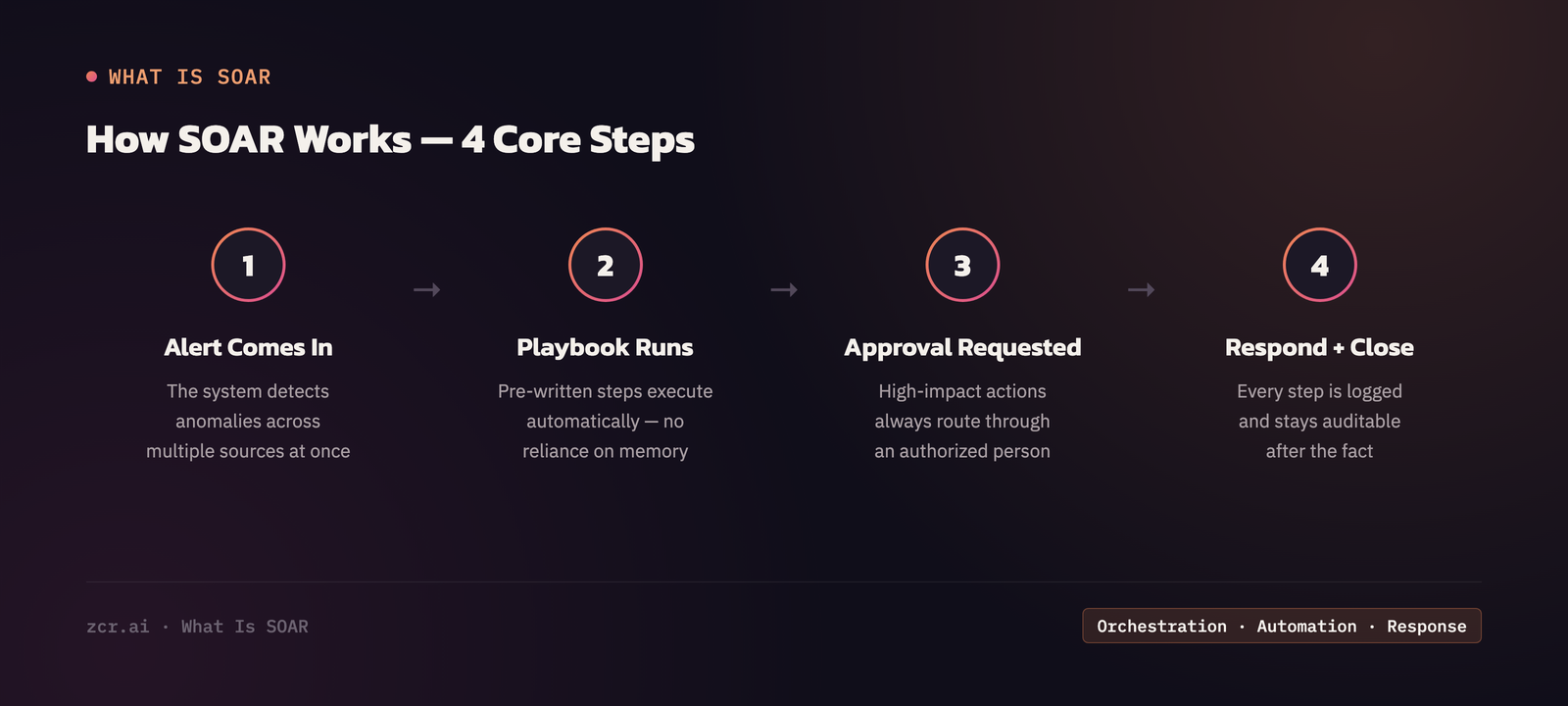
1) Playbooks are pre-written, versioned response steps — for example, "on a confirmed phishing case: enrich the IOC → notify the mailbox owner → purge the email from every mailbox." Write it once, run it as many times as needed, without depending on one person remembering the exact sequence.
2) Case management tracks every incident through a clear lifecycle (new → triaged → in progress → contained → closed), with an SLA timer on each stage.
3) Approval workflow is what makes automation safe enough to actually trust — any high-impact action (deleting data, disabling an account, isolating a host) always routes through an authorized person first. Automation doesn't get to make every call on its own.
4) Attack flow visualization maps out each case's attack chain visually, tagged against MITRE ATT&CK — entry point, the steps the attacker took, and where the system finally caught it, all in one picture. Useful in the moment, and just as useful when you're walking management through what happened afterward.
Signs Your Organization Is Ready to Look at SOAR
Smaller teams with a light alert volume can hold off — but once several of these show up, it's worth a serious look:
- Analysts spend more time copying data between tools than actually making decisions
- The same repeatable response (like blocking a confirmed-bad IP) still gets done by hand every single time
- Nobody can answer "what stage is this case at" cleanly when an auditor asks
- The team is growing (more clients if you're an MSSP, wider scope if you're in-house) faster than headcount
Recognize two or three of these? zcrSOAR was built specifically to close that gap.
zcrSOAR Does All of This Today
zcrSOAR covers all four pieces above in one platform — versioned, testable playbooks; case management with SLA tracking; a role-based approval workflow (operator vs. admin) with timeout escalation if nobody signs off in time; and an attack flow builder that auto-tags MITRE ATT&CK techniques.
If you're weighing when to bring SOAR in, check zcrSOAR's plans against your current team size and alert volume.
Get in Touch
Not sure if your organization is ready for SOAR? Our team offers a free consultation.
Sources